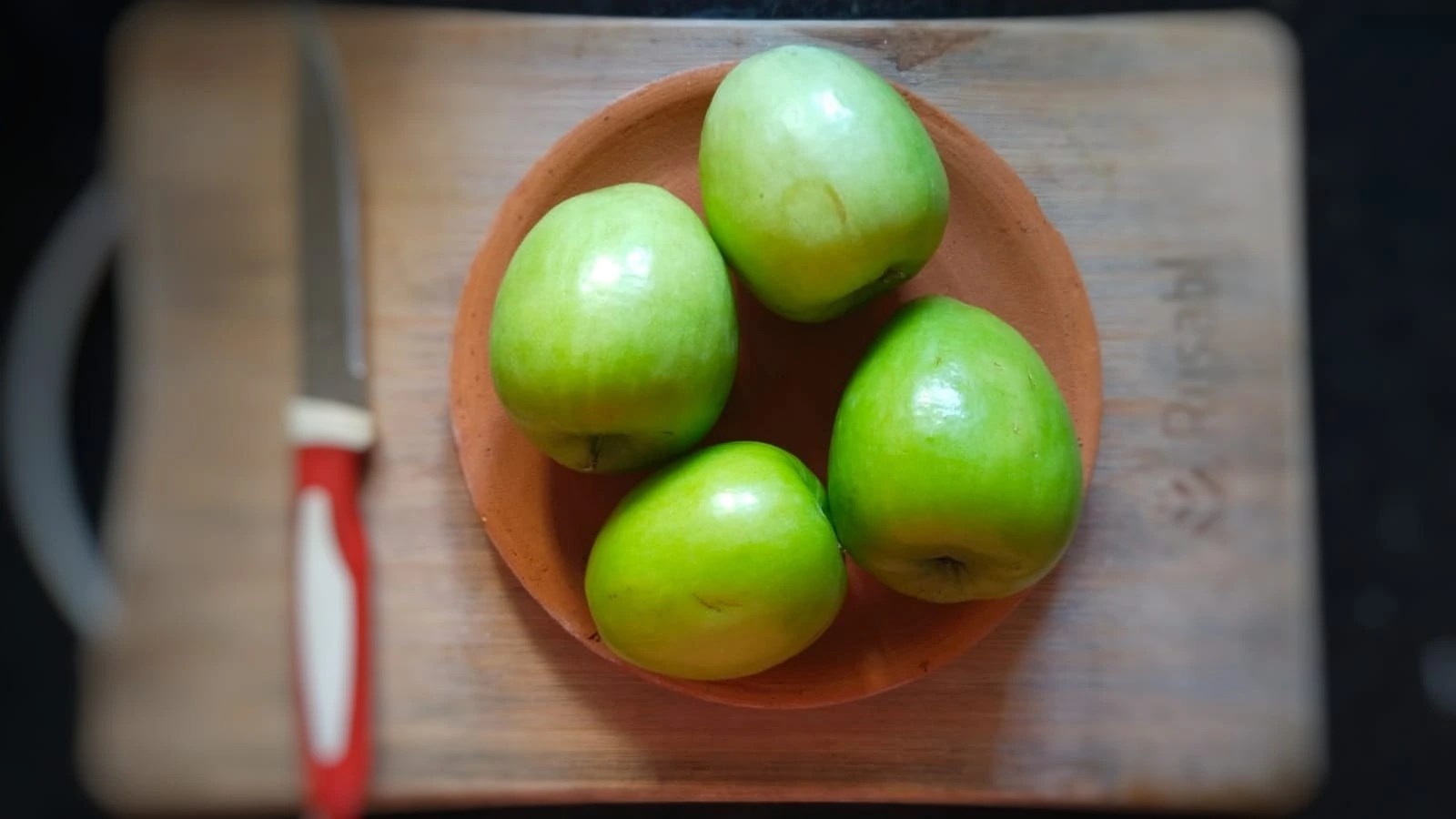
When I finally saw my favourite winter fruit with the fruit vendor, I instantly picked it up, wiped it clean on my t-shirt, and impatiently took the first bite. Yeah, yeah, I know that I need to wash it at least ten times before eating it. But some things you just can’t resist.
As soon as I bit into it, the sound of its crisp crunch fell like music to my ears, the juice gushed out with abandon, the slight tartness mingled comfortably with the sweetness and kept dancing in my mouth. A deep satisfaction descended upon me—it felt like meeting an old friend after a long time. Then I finally told the fruit vendor, “Give me five kilos,” he looked at me with curious eyes. But I didn’t care; it is an apple ber and I love ber in all its forms.
Ber Fruit & Me
My connection with ber goes back to my school days, when they sold it right outside the school gate. I would rush out of school with my heavy bag, and buy a small pouch of small red ber, which would be mixed with salt and red chilli powder, and then leisurely munch on each one as I walked back home. There was no hurry in the world; time was in abundance and at that moment I could cherish each bite like there was no other.
So, every time I see ber, it transports me to that era of my life. Now I have to force myself to slow down intentionally. Ah, well, growing up does that to you.

These tiny red ber grow wildly in the forests and everywhere and hence are not commercially available. You only find them with small time vendors and in the local markets. And like all forms of ber, their taste is a mix of tartness and sweetness; I guess that’s why kids are attracted to it. By the way, these tiny red bers are called chaniya maniya in Maharashtra, at least where I grew up. The English name is jujube. But I like the name we have for it – chaniya maniya – it has such a sweet musical ring to it.
Ber in Indian Mythology & Folklore
There are different varieties of Indian jujube across India. It is known to be one of the most ancient and common fruits in India. So, you find it to be a part of lot of folklore too. One of the popular stories is that of Ram visiting Shabari in the forest while he was on exile. Shabari tastes every ber to make sure that it’s sweet, and then offers it to Ram, who happily eats it.
Ber is also Shiva’s favourite fruit. It is offered to him during Mahashivratri which coincides with the season as it falls during late winter. It boosts immunity and aids digestion, hence it’s especially good for people who fast during Mahashivratri. The spiritual thought behind it is that Shiva doesn’t ask for grand gestures, just purity of intention; hence he is happy with this simple, widely available fruit. One fruit so beautifully links culture, season, devotion and health.
The famous Badrinath temple also has a connection to the berry tree. Badri means berry or jujube tree and nath means lord, so it literally means the lord who dwells amongst the berry trees.
Berry trees are found in many stories connected to sages who have meditated in harsh conditions as these trees can survive in the most challenging conditions. So, sages used them for shade and food.

Ber fruit & Spirituality
One such popular ber tree is the Ber Baba Buddha Sahib at the Golden temple, it is said that Baba Buddhaji meditated under this tree. If you ever visit you”ll find it close to the Amrit Sarovar (pool). It is considered to be around 440 years old, which is four times its usual life. Another ancient ber tree is called the Dukh Bhanjani tree, which means that it removes all suffering. When I visited the Golden Temple for the first time, I saw this unassuming tree and didn’t think much of it. But when I saw people collecting the leaves that were falling from the tree and keeping them like a blessing, I realised that it’s much more than it seems. My judging mind learnt a lesson.
So, next time you see a ber, don’t underestimate its power; it looks simple but definitely packs a punch.
If you read ancient texts, then you’ll know that ber is one of the oldest cultivated fruit trees in human history, almost 11,000 years ago. It has taken various forms over the years and the modern version of it that you see flooded in the market is the apple ber. Yes, the green one, big in size and crunchy in taste. This variety was created in Thailand and has found its way to India and we happily eat it as it is always modestly priced.
When I had asked my fruit vendor why it’s called apple ber, his answer was simple – because it looks like a green apple and tastes like ber. Simplicity is at the core of what ber stands for and apple ber does that well too.
Like all our culinary adaptations, this apple ber has found its place in kitchens and recipes, from ber ki chutney, ber salad, ber chaat, to ber jam. My favourite is ber pickle; it’s my way of getting a chance to eat my favourite winter fruit way after the season is over. Because a fruit like this that is humble yet extraordinary needs to be cherished.
Here’s my simple Kerala style apple ber pickle recipe you can try.
Apple Ber Pickle Recipe
1 kg apple ber
1 teaspoon salt
2 tablespoon sesame oil
½ teaspoon mustard seeds
½ teaspoon fenugreek seeds
¼ teaspoon asafoetida
1 sprig of curry leaves
1 teaspoon turmeric powder
1 tablespoon Kashmiri chilli powder
1 teaspoon white vinegar
Steps:
Wash apple ber and wipe them well. There should be no moisture, otherwise the pickle will get spoiled quickly.
Cut into small cubes.

Add salt and keep it aside for 30 minutes.
Take a mortar and pestle and coarsely grind mustard and fenugreek seeds.
Heat a pan, add oil, then add the mustard and fenugreek powder and stir for a few seconds. Then add asafoetida and curry leaves and keep stirring. Add turmeric powder, chilli powder and vinegar and stir for 4-5 seconds. Add the ber pieces and mix well. Switch off the gas and leave it to completely cool. Once cool, transfer it to a container.
Your pickle is ready to be served with hot rice and dal. Enjoy!

About me: I’m a vegan writer, a wanderer at heart and someone who loves to cosy up with a book. After nearly two decades in television, I now tell stories that are plant-based, personal and rooted in the life that I’m building along the way. To know more click here.
